Imagine advertising a steak special to a room full of vegans. You'd miss the mark completely.
In today's war for talent, that's what recruiting through your HR department or internal talent acquisition team looks like without a sales and marketing strategy behind it. In the current job market, finding and keeping top talent is an art, not just a challenge. The key to winning the talent war is treating recruitment like an ongoing marketing campaign.
Anyone who's taken a marketing course knows the STP model: segmentation, targeting, and positioning. Apply that same thinking to talent acquisition, and it looks like this:
- Segmentation: dividing the job market into distinct groups of candidates based on industry, department, seniority, location, education, and more
- Targeting: deciding which candidate segments to focus your communication efforts on
- Positioning: creating tailored communication and outreach campaigns that resonate with your selected candidate audience
Leveraging these sales and marketing tactics transforms recruitment from a traditional HR function into a strategic initiative that attracts the best and brightest talent.
Why HR-Led Talent Acquisition Falls Short in Today's Market
Sales isn't a skill typically associated with HR departments and internal talent acquisition teams, because it hasn't historically been a required competency. HR teams excel at training, performance management, organizational design, and other people-oriented functions, but recruitment has grown into a bigger function than most HR teams have the bandwidth to run effectively. The bulk of talent acquisition is a sales process: proactively building relationships with potential candidates, selling them on the opportunity, and converting them into productive employees when the need arises.
Here's why talent acquisition falls short without a sales and marketing strategy behind it.
Operational mindset. Many internal talent acquisition teams treat recruitment as a transactional process, simply filling roles as they open. This gets positions filled, but it misses the best candidates and fails to retain them long-term. The traditional process reacts instead of building a robust talent pipeline and engaging potential candidates long before a role opens.
Limited strategic outreach. Internal recruitment teams and HR departments post job openings and wait for applicants. This approach cuts off direct outreach to top candidates already doing great work elsewhere, on top of the overwhelming volume of automated applications technology now enables. Without direct connection to passive, gainfully employed candidates, you're operating at a disadvantage: you're not reaching the talent that's actually out there. That gap in outreach and relationship-building means settling for whoever's available, not necessarily the best fit for the team.
Slow adaptation to market trends. The recruitment landscape evolves fast, with new technology and shifting cultural trends. HR teams managing a wide array of responsibilities fall behind these changes, and traditional talent acquisition processes lag behind market trends as a result, leading to outdated strategies that don't attract modern job seekers.
Overwhelmed by advanced tech with a post-and-pray strategy. AI-assisted job searching overwhelms HR departments and underwhelms results. Candidates increasingly use AI to craft resumes and cover letters and to automate instant responses to unlimited job postings. This flood of applications, many of them AI-generated, overwhelms HR departments with unnecessary volume and complicates the vetting process.
How a Sales and Marketing Strategy Boosts Your Recruitment Efforts
A sales and marketing strategy means more than creating an Employee Value Proposition and calling it done. It means implementing a set of awareness, engagement, and relationship-building tactics from the pre-candidate stage all the way through onboarding. Marketing creates the demand. Sales fills it. Here's what that looks like in practice.
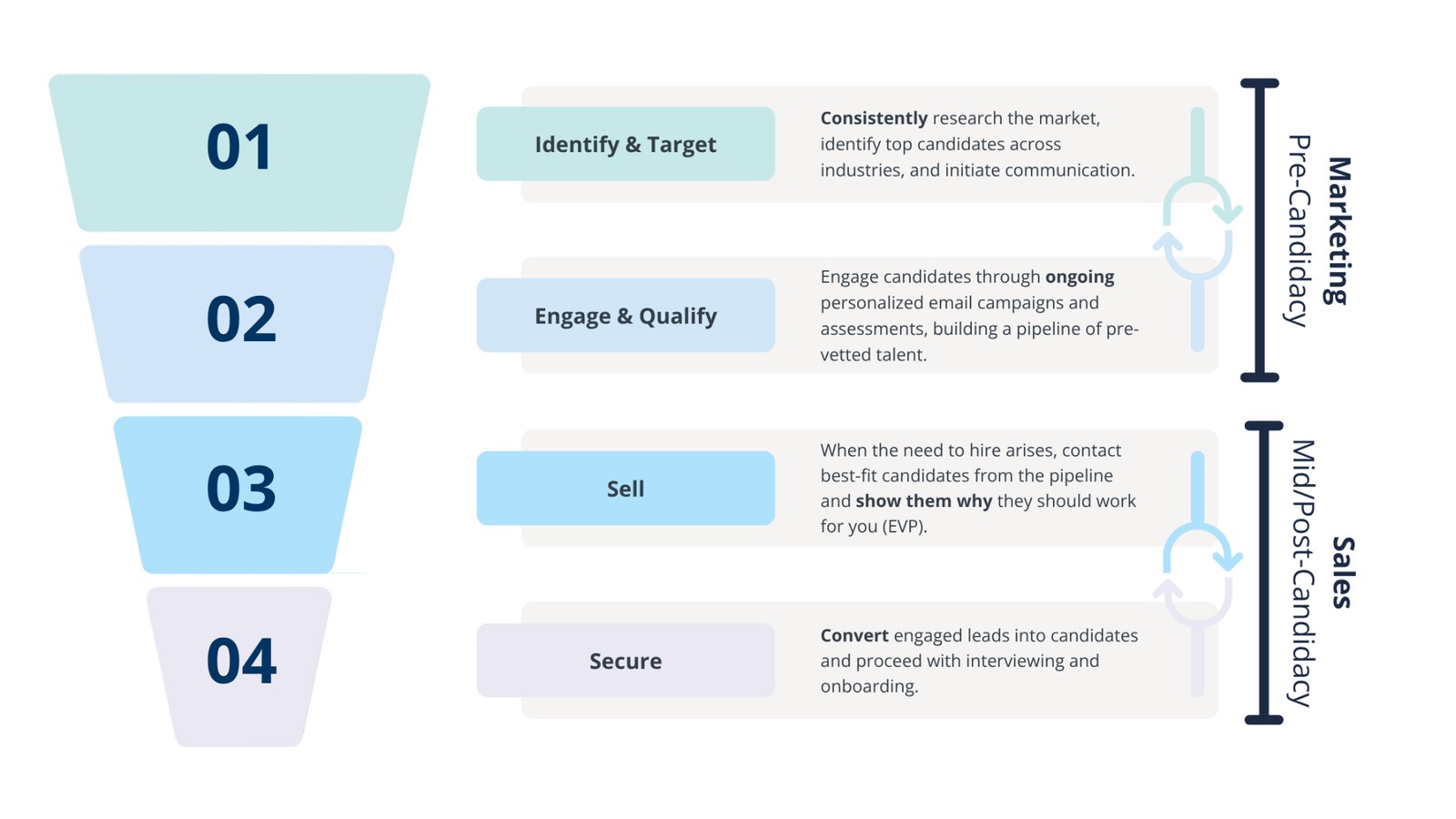
Identify and target. Start by understanding the market: who are the top players, what skills are in demand, and where do you find these candidates. Consistently researching the market pinpoints the best talent across industries and opens the door to direct communication. The best candidates usually aren't looking for new opportunities, which means posting on LinkedIn or other job boards doesn't reach them. Creating demand for a new opportunity takes marketing skill. Marketers know how to target specific audiences and connect with people who aren't actively job hunting but could be the perfect fit for your team. It's about casting the net wider and smarter.
Engage and qualify. Once you've identified potential candidates, engage them directly through personalized LinkedIn and email campaigns, messaging, and in-person conversations. Tailored assessments and communication materials build a clearer picture of their skills, strengths, and professional background. Networking and personal connections drive a significant share of hires, which makes tapping into existing networks and building relationships with potential candidates essential. The goal is a pipeline of pre-vetted talent interested in joining your team when the need arises. This goes beyond posting a job opening and hoping for a good candidate. It's about being a consistent ambassador for your brand in the job market.
Sell. When the need to hire arises, shift to a direct approach: contact the best-fit candidates in your pipeline and sell them on why they should work at your organization. Sales expertise positions your organization as the top choice through compelling pitches that draw the best candidates into the interview process, with your EVP as the core of the pitch. Building relationships and nurturing leads turns into candidates who feel valued and excited about the prospect of joining your team. Handling objections, concerns about compensation, location, and career growth potential, is a critical part of the sales process, and it requires a deep understanding of the market along with the ability to negotiate and make a compelling counterargument.
Secure and retain. Once candidates are on board, the focus shifts to securing their commitment and closing the deal: converting engaged leads into new hires through interviews and onboarding. Every interaction, from the first whisper of interest to signing the employment contract, shapes a candidate's perception of the organization. Sales-oriented people act as brand ambassadors, designing seamless, engaging experiences that leave a positive impression whether or not the candidate ultimately joins.
How to Build a Sales-Oriented Talent Acquisition Strategy
Step 1: Collaborate with your marketing team, if you have one.
Build a strong partnership between HR and marketing:
- Joint strategy sessions. Hold regular meetings where HR and marketing teams brainstorm and develop a unified recruitment strategy, keeping everyone aligned toward common goals.
- Unified branding. Keep your employer brand consistent with your corporate brand. Marketing teams help craft an Employee Value Proposition that resonates with candidates and aligns with your overall brand identity.
Step 2: Leverage the expertise of search firms with a sales and marketing skill set.
Search firms and embedded recruitment providers with a sales and marketing philosophy, like Oxford + Richmond, become powerful allies in the quest for top talent. Specialized firms like Oxford + Richmond take on the sales and marketing role directly and build your pipelines.
Here's how to integrate that expertise into your talent acquisition strategy:
- Define clear objectives. Work with a search firm to define clear recruitment objectives and target candidate profiles, giving them a deep understanding of your culture, values, and the specific needs of the roles you're hiring for.
- Use their networks. Search firms bring extensive networks and access to passive candidates who aren't actively looking but are open to new opportunities. A specialized firm like Oxford + Richmond complements those networks with true search to build a curated pipeline specifically for your needs.
- Run targeted campaigns. Work together to create targeted marketing campaigns that reach specific segments of the job market. Search firms provide insight into what attracts candidates in your industry, while your marketing team designs engaging, persuasive content. Without a large marketing team, your search firm can take this on directly.
- Build a data-informed feedback loop. Establish a feedback loop with your search firm to continuously improve the process. Their insight sharpens your marketing strategy and keeps it aligned with market trends and candidate preferences. At Oxford + Richmond, we use advanced technology, AI, and analytics to inform every decision, so you're always positioned to find the best talent.
Recruitment is marketing. If you're a recruiter nowadays and you don't see yourself as a marketer, you're in the wrong profession.
— Matthew Jeffery, Global Head of Sourcing and Employment Brand at SAP
FAQ
Why does recruitment need a sales and marketing approach today? The best candidates usually aren't actively job searching. Reaching them requires the same targeting, positioning, and relationship-building tactics marketers use to reach a customer, not a job posting waiting for applicants.
What does a sales-oriented hiring process actually look like? It runs through four stages: identifying and targeting the right candidates, engaging and qualifying them over time, selling them on the opportunity when a role opens, and securing their commitment through a strong onboarding experience.
How can a company without a marketing team apply this approach? Partnering with a search firm that brings its own sales and marketing capability, like Oxford + Richmond, fills that gap directly and builds a curated candidate pipeline on your behalf.
The Bottom Line
Bringing sales and marketing into the recruitment fold means building a team of talented people excited to be part of your organization's journey, not just filling roles. It's about telling your story in a way that captivates and inspires, selling candidates on the opportunity, and ultimately attracting the talent that helps your business thrive and grow.